I was a reading a post by my fellow war gamer and blogger Nick Jebson over at HMS Distraction about the arms race that seems to be going on with Warhammer 40k. Were each race gets a bigger or bulkier squad or model. Nicks prime exhibit of this was the space marine Centurions, a new unit in the up and coming new space marine codex (image below).
Now this isn't a new phenomena, its been going on for some time (the past couple of years in fact) were 40k armies get ridiculous models that catch your eye by with sheer mass and insanity. Be it the Grey Knights Nemesis Dreadknight (codex release date April 2011), the Tyranid Trygon / Mawloc / Tyrannofex / Tervigon (codex release date January 2010) the Space Wolf Thunder Wolves (codex release date October 2009) the Tau Riptide (code release date March 2013) or the Eldar Wraith Knight (codex release date June 2013) many of GWs new 40k armies have had at least one unit that is bigger and bulkier than is really necessary.
Now my personal hypothesis as to why this is stems from who the target audience of 40k is.40k is targeted at the younger audience, early to mid teens who have played Call of Duty, like big explosions and huge stompy/shooty things. 40k has always been the system that has attracted the younger audience, its simpler and faster than Fantasy and having your troops fire lazer guns is far cooler than having them fire bows and arrows (although sometimes the bow and arrow kills more than the lazer gun). My personal Hypothesis is that by ensuring that the majority of 40k armies have big stompy models this will attract more young COD players who will buy (or get there parents to buy) their outrageously expensive models thus ensuring a steady flow of cash for GW.
I kinda of hope that i am wrong, but i have a sneaking feeling that i might be right.
Edit: I have been told that i may have made my point badly and that it came across as me ripping into 40k and its players. That is not true. I have played 40k and still do. All i am saying is certain 40k models look dumb and that GW has targeted 40k towards a younger audience, i am not in anyway saying that all 40k players are in their early to mid teens, that would be blatantly wrong. I apologize if i came across as ripping into 40k and its player base this was not the case.
Until next time
Rex
Labels
40K
(43)
9th Edition
(8)
Alternate Games Workshop Models
(4)
Army List
(7)
Battle Reports
(30)
Beastmen
(3)
Black Library
(2)
Book Review
(3)
Chaos Space Marines
(5)
Commando
(1)
Commission
(2)
Dark Elves
(8)
Demons
(3)
Dwarfs
(3)
Eldar Corsairs
(1)
Empire
(3)
End Times
(3)
Fantasy
(92)
Fantasy and 40k
(4)
Firestorm Armada
(11)
Flames Of War
(2)
Grey Knights
(3)
Halo
(1)
Hobby Related Content
(68)
Kings of War
(13)
KOW Elves
(2)
lore post
(5)
Mantic Games
(9)
Misc
(17)
Models
(32)
Mordheim City of the Dammed
(1)
Narrative Battle Report
(11)
Necrons
(1)
Non War Gaming Related Content
(12)
Orks
(3)
Planetfall
(4)
Role Play
(3)
Rouge Trader
(3)
Spartan Games
(1)
Tactics
(1)
Tanith First and Only
(3)
The 9th Age
(1)
The Fantasy Genre
(2)
The Mantica Story
(2)
The Path to CTA 2016
(3)
The Young World
(2)
Tournaments
(31)
Vampire Counts
(1)
Wood Elf Army Book Review
(3)
Wood Elf Rumors
(7)
Wood Elf Tactics
(9)
Wood Elves
(63)
Saturday, 17 August 2013
Tuesday, 13 August 2013
Fantasy and 40k: Psykers and Magic
Magic is a big part of Fantasy, so big that it gets its own phase and the majority of Fantasy players lists will include a mage. For 40k pyskers, and psykic powers, are a small part of their game. Psykic powers are part of the shooting phase and Pyskers aren’t seen as key to many 40k lists. This post will examine the difference between how Fantasy and 40k treat magic, and will look at why pyskers have such a small roll compared to key position held by mages in fantasy.
40K
In 40k a player generates warp charge tokens equal to the
total combined warp mastery level in his army, also the warp mastery level is
also how many spells a psyker can know in one game. He can then spend these
tokens to use psykic powers, activate force weapons in close combat or similar
things. Each psykic power has a cost to use it e.g. Power A costs one charge
token to use and power B costs 2. Once a player decides upon a power to use he
subtracts its costs from his warp token pool and takes a Leadership test, if
the test is passed then the power is cast and the effects are resolved, if he
fails the test then the power fails to take effect. If the player rolls a double one or six then
the model who tried to cast the power suffers 1 wound with no saves allowed,
(referred to as “perils of the warp”). If the power targets a squad then they
can try to prevent the power from having any effect by rolling a 6 on a d6
(referred to as Deny the Witch). The 40k rule book has 6 standard power lists
with the newer codices having race specific lists.
Pros
- The system is similar to the old fantasy one, where having higher level pyskers is worth more than knowing a few more spells.
- The system is yards better than it used to be with psykic powers being a more in depth game mechanic. To add to this the rulebook powers are more than just place holders with many of the power lists having serous bite to them.
Cons
- With the lack of any real basic dispel mechanic, older armies will find it hard to defend themselves against pyskers.
- Without the danger presented by a miscast table, and perils of the warp doing little to punish failed attempts, there is no real reason for players not to spam their best power and blast their opponents with little concern for the potential risks.
Fantasy
In Fantasy each mage knows a number of spells equal to their
wizard level. Each player gets a power
dice pool at the start of their magic phase, the power dice are equal to the
roll of 2d6, and their opponent gets a amount of dispell dice equal to the
highest d6 from their opponents 2d6 roll, the maximum amount of power/dispel
dice a player can have in his/her pool s 12. Each spell has a casting level
which players must equal to or beat with the roll from however many of their
power dice they decide to use on any one given spell, some spells give the option
for a boosted version of the spell which will have a greater effect .Also the
wizard who is casting the spell can add his wizard level to the dice result,
the maximum amount of dice that can be used to either cast or dispel a spell is
six. The opposing player can then decide to attempt to try and dispel a
successfully cast spell by equaling or beating his opponents power dice roll,
he adds his/hers highest wizard level to the dispel attempt. A roll of a double six for casting results in
the spell being automatically cast and immune to dispel attempts however the
casting mage must roll on the miscast table. A double six on a dispel attempt
automatically dispels the spell regardless of casting result.
Pros
- Each army gets has an equal chance of getting a high power dice pool.
- Regardless of how many wizards are in a army, each army will have a decent sized dispel pool
Cons
- There is now virtually no point to taking a level 4 wizard over a level 3, as the level 4 only offers 1 more spell and +1 more to the casting result.
Conclusion
In 40k the shooting phase is often a game changing phase,
with weapons powerful enough to remove whole units in a single shot. This is
could be part of the reason why pyskers aren’t a must have in 40k armies. While psykic powers are powerful many of the
40k weapons do what pyskers do only better (and without a chance of hurting
themselves). One example of this is a space wolf rune priest with living
lightning (a range unlimited, strength 7 AP 5, Assault D6 psykic power)
compared to a squad of grey hunters with bolters. While the psykic power does
have a longer range and higher strength the squad of grey hunters can pump out
more shots and only has to roll to hit and wound, whereas the rune priest has
to roll to cast, then to hit and to wound. Considering that a rune priest cost
100 points(and comes from a HQ slot, where other more useful options compete
for those force org slots) and 10 grey hunters costs 150 points (and take up a
troops slot where there is only one ,worse, option) it’s easy to see why many
40k players forgo pyskers in favor of other HQ options, confident that other
units in their army can do the job of pyskers.
Compare this to Fantasy where the main job of the shooting phase
is to weaken units for combat or panic units (and thus delay them while they
rally) and it’s easy to see why mages are often included in a fantasy force.
Often Fantasy magic will be far more destructive than fantasy shooting (this is
helped by strength modifying the armour save in Fantasy and high armour saves
being relativity rare). A boosted fireball spell can do more damage than any unit
of archers in the game due to its 2d6 hits, not needing to roll to hit and high
strength. Fantasy magic is not outshone by other parts of the army, and as such
it has such a respected place in most Fantasy list. Whereas 40k pyskers are often
outshone (on both the destructive and buff front) by other parts of a 40k force.
Hopefully you enjoyed this post, next time I will take a
look at both systems shooting phases and how they affect the rest of the game.
Until next time.
Rex
Saturday, 10 August 2013
It lives!!!!
Usually i dont post images of models that aren't painted. But as this model took me two weeks, a bottle of superglue, and about 5 paper clips (for pinning purposes) i thought i may as well post a few images of the completed model. So here it is, a Scibor Celtic Mech that will fill the role of a venerable dreadnought in my space wolf army.
Edit: Lo the masses did ask "Lord show us a comparison" and the lord made it so
Friday, 9 August 2013
Fantasy and 40k: The Movement Phase
It is undeniable that 40k and Fantasy's movement phases share certain aspects yet are also different enough from one and other to be called separate rules sets. 40k's movement system can be called stream lined where as fantasy's system is a more tactically minded one. As the movement phase is more than just movement this post will look at the Movement Mechanics of each system and how terrain effects movement in both systems.
40K
1)Declare charges. The player declares which units will be charging who, and then resolves each individual charge before moving onto the next unit.
3)Compulsory moves. Any unit that has to make a non-voluntary movement does so now, after charges but before remaining moves. Also any fleeing units can try to rally.
4)Remaining Moves. Any unit that has not moved yet, either as a charge or compulsory move, can do so now.
1):Open Ground. Open ground has no effect on unit movement
2):Dangerous terrain. Like 40k and model that moves through difficult terrain must pass a
dangerous terrain test or suffer a wound without armour saves.
3):Impassable terrain. Impassable terrain cannot be crossed.
40K
Movement Mechanics
In 40k the majority of models move 6 inches in the movement
phase, with exceptions being calvary,
jetbikes, jump infantry, beasts and bikes (who all move 12 inches) ,and
vehicles (whose movement is based on the type of vehicle). In terms of the
direction a squad can move the player simply turns the squad in the direction
they wish to move and then moves the squad.
Terrain Effects
In terms of the effects of terrain on movement in 40k open
ground has no effect on movement. Impassable terrain cannot be moved through. Lethal
terrain cannot be moved through in addition any model that touches lethal terrain
dies instantly with no saves of any kind allowed. Difficult can be moved through however any
squad or model that wishes to move through difficult terrain must roll 2D6 and
pick the highest as their movement value. Dangerous terrain works exactly like
difficult, in addition each model that passes through dangerous terrain must
roll a dice, and on a roll of 1 that model suffers a wound with armour and
invulnerable saves allowed (referred to as a Dangerous terrain test) .
Different model types are effected differently by terrain,
for example Calvary ignore the movement
reducing effects of difficult and dangerous terrain but must take a dangerous
terrain test when moving through difficult and dangerous terrain.
Pros
- The 40k movement system is by far less complex than the fantasy, allowing for a quick and fast movement phase.
- Terrain rules are simple and straight forward.
- With every model (regardless of race) moving a set distance the 40k movement phase is streamlined and straight forward.
Cons
- The more difficult tactical maneuvers of Fantasy don't work in 40k due to the fact that there is no penalty for turning your squad to face a new direction, and that the squad formation in 40k is very loose compared to the tight unit formation of Fantasy.
- With Charge moves being moved to the assault phase, and having the option to “Run” models in the shooting phase there is movement going on in every game turn, and given that newer armies take advantage of this it can leave the older armies at a severe disadvantage.
- Lethal terrain, if not properly defined, can cause arguments during game given the extreme effects it has on models that enter it.
Fantasy
Movement Mechanics
In Fantasy every model has a individual movement
characteristic, a model can make a normal move up to the maximum value of that
movement characteristic or can march, in which case they can move up to double
that movement characteristic, however you cannot march if you are within 8 of
an enemy unit or model unless you pass a leadership test first. The Fantasy
movement phase is very structured and each movement phase is broken down into
various steps that must be followed in a particular order, those steps are as
follows:
1)Declare charges. The player declares which units will be charging who, and then resolves each individual charge before moving onto the next unit.
2)Resolve Charges. The individual charges are resolved,
with the unit being charged either standing and holding (standard charge
reaction where the unit braces for the charge, has no additional effect),
Standing and shooting (a optional reaction for a unit with ranged weapons, the
unit can make a shooting attack, at -1 to hit, before the charge hits) or
Fleeing (the unit runs directly away from the charging unit 2d6, unless the
charging unit can redirect the charge, a leadership test, it counts as a failed
charge), after the reaction has been resolved each charging unit moves 2d6 plus
the movement characteristic of the unit.
3)Compulsory moves. Any unit that has to make a non-voluntary movement does so now, after charges but before remaining moves. Also any fleeing units can try to rally.
4)Remaining Moves. Any unit that has not moved yet, either as a charge or compulsory move, can do so now.
Moves like pivoting and turning count towards moving the
total distance a unit can move, for example a unit of Wood Elf Glade Guard
turns to the left of its current position (which say takes 3 inches) it can
them move 7 inches forward.
Terrain Effects
Terrain has been simplified in Fantasy, there are 3 types of
terrain:
1):Open Ground. Open ground has no effect on unit movement
2):Dangerous terrain. Like 40k and model that moves through difficult terrain must pass a
dangerous terrain test or suffer a wound without armour saves.
3):Impassable terrain. Impassable terrain cannot be crossed.
Pros
- The Fantasy movement system allows for tactical maneuvers and sneaky movement tricks
- Each army has a base movement value that compliments its play style making for a more unique feel per army
- As the terrain system is fairly simple less time is spent debating whether a forest is difficult or dangerous terrain.
![]() |
| In this selection of images we see how a wood elf player Maneuvers in between the two units of zombies to prevent them from charging the unit. |
![]() |
| Please note that the wood elf player deserves to have dice thrown at him for playing this trick |
Cons
- The Fantasy movement phase takes far longer as it is more complex than 40k
- Due to how models are placed in their unit arguments can easily begin about how many models in a unit should take Dangerous terrain tests.
Conclusions
The movement phases of Fantasy and 40k echo their deployment
phases in that 40k is streamlined,
allowing for a fast movement phase, and Fantasy is complex, allowing for more
tactical moves. While a streamlined system is good it removes a fair bit of
tactics from the 40k movement phase in order to be as streamlined as it is. And
while there is a certain amount of boundless glee to be gained from pulling off
a tricksy fantasy maneuver newer and inexperienced may be put off doing some
of the more cunning tricks due to the many rules that surround the Fantasy movement
phase.
Hopefully you have enjoyed part 2 of the Fantasy and 40k
series, at some point in the future part 3 will be published which will look at
the Fantasy magic phase and 40k psychic powers.
Until next time.
Rex
Sunday, 4 August 2013
The Thunder Wolves ride
I know i said that my next post after the CTA wrap up would be the next Fantasy and 40k post but tonight i finished my Wolf Lord on Thunder wolf ( this is the model that has taken weeks to complete) so here he is, Ulfar on his Thunder wolf (as of yet un named, if you do think of a name post it in the comments)
I solemnly promise that they very next thing i post will be the 2nd part of the Fantasy and 40k series. Until next time.
Rex
I solemnly promise that they very next thing i post will be the 2nd part of the Fantasy and 40k series. Until next time.
Rex
Bloodied, Awed and Triumphant. CTA Day 2
Well CTA has come and gone and i found day 2 better than the first. 2 Games that were polar opposites of one and other, and plenty of lessons learned, so lets get right to them.
Game 4. Fern Campbell, Meeting Engagement.
Game four was against Fern Campbell's Orcs and Goblins and it reinforced why wood elves aren't best friends with the greenskins (apart from the fact that orcs aren't really "friends" with anyone). Fern's list was gunline done orc style and from turn one it made its presence felt. All my archers took damage from the orc artillery and even the treeman were hurt by goblin (GOBLIN!!!!) poisoned bow fire. Painful moments for me included my level 4 mage double sixing throne of vines and then failing the 2+ miscast save and blowing up some of my fragile elves. In the end it was a 17-3 to Fern, and justly deserved win to Fern as she played very well.
Game 5. Regan Ridge. Battleline.
Game 5 (the "kill em" scenario) was against my new favourite army to face. Vampire Counts. This game showed the might of the treemen as they alone accounted for a whole unit of grave guard, a vampire lord, a banshee, a unit of ghouls, a underling vampire, a necromancer and a unit of skeletons. My wonderful treeman ancient (Mr Huggy) added another vampire lord to his kill count. The glade guard must have been inspired by the treemen as the unit of 16 charged in to finish off the mortis engine. In the end i wiped out his army and had all my treemen standing. The result was a staggering 19-1 to me. Regan was a very good opponent who hopefully learned the danger of treemen ancients.
In the end i came 23 out of 26, this is mostly due to the penalties put on my battle points by not having a fully painted army. My MVM (most valuable model) was Mr Huggy for continually holding the line and earning me points. It was a very enjoyable weekend and i look forward to my next tournament, Warpfire, on September 14th.
I will leave you now with images from day 2. Enjoy and until next time
Rex
![]() |
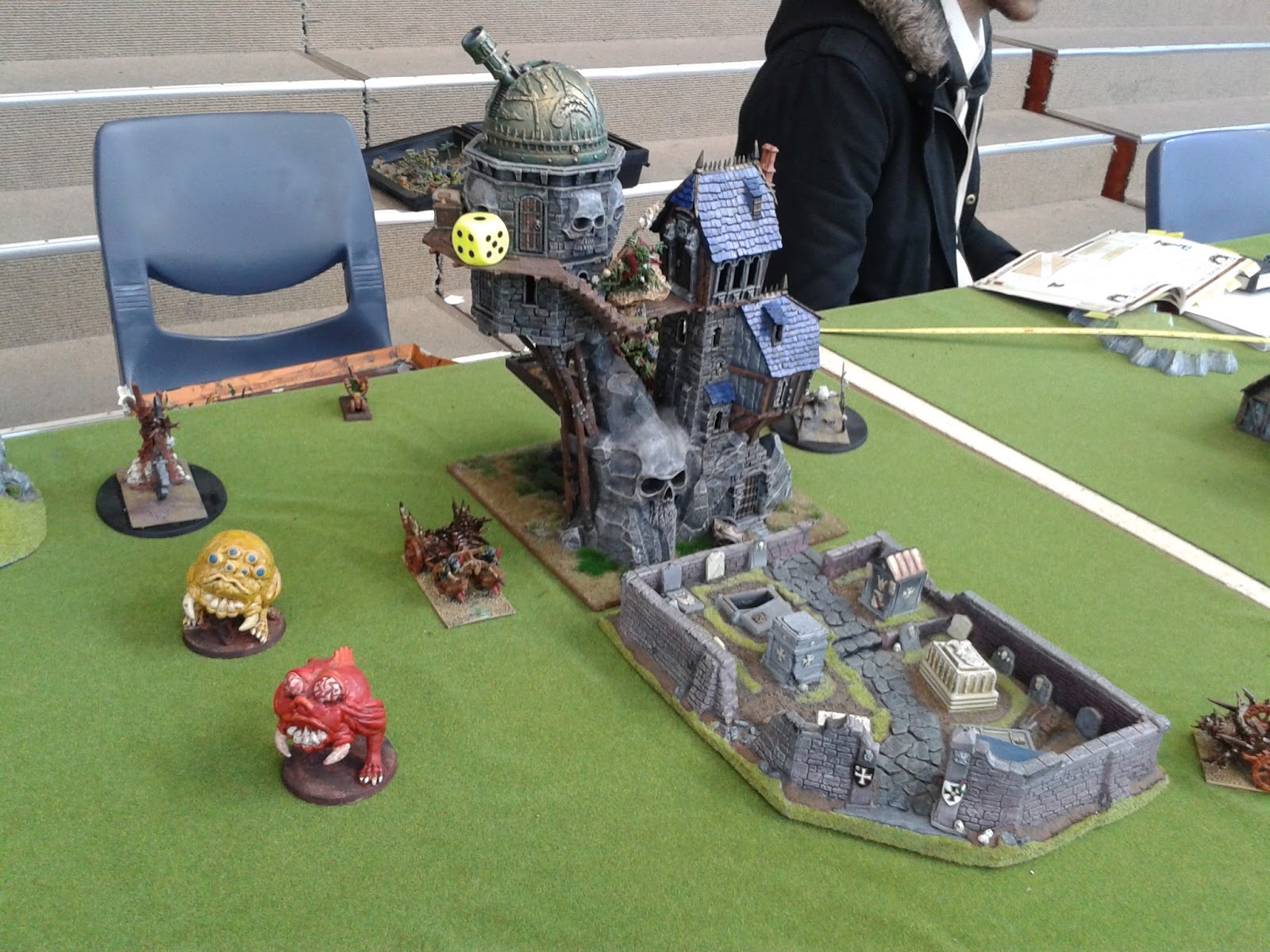
| The slightly mad wizard's tower |
![]() |
| Bellow are a images of the 40k Ork battle field |
![]() |
| The most intact 40k city i have ever seen |
![]() |
| Winter Eldar |
![]() |
| The head of a "Titan" (note that doubt this is the head of a actual titian as titans dont die) |
![]() |
| The front view of a winterknight and winterwalkers |
![]() |
| Dwarfs. Nuff said. |
![]() |
| More |
![]() |
| The Runelord sleeping on the Anvil of Doom |
![]() |
| "Really you fit armour inside that bottle?" |
![]() |
| Centaur wild riders |
![]() |
| Mr Huggy my MVM (most valuable model) |
![]() |
| Game 4 before the slaughter |
![]() |
| Orcs and giant dice. In a wizard tower? Whatever next. |
![]() |
| Wait how did it get behind us? |
![]() |
| STOMP (didnt kill the mage) |
![]() |
| Mr Huggy soloing the trolls (it didnt go well) |
![]() |
| 40k maddnes |
![]() |
| Tau and space marines fighting for a ork town |
![]() |
| Modern Warfare table top style |
![]() |
| The NZ defense force. So powerful they had to be kept in a glass box. |
![]() |
| World war two table top gaming (not flames of war) |
![]() |
| A quaint, quite and peaceful town. For once. |
![]() |
| His smile says it all. |
![]() |
| You think thats a forest! |
![]() |
| High elves |
![]() |
| A dragon so powerful it partially blinded the camera |
![]() |
| In Communist Kislev you dont kill undead, undead kills you! |
![]() |
| "Flames" of war |
![]() |
| A inspirational hell pit abomination |
![]() |
| Tzeentch tomb kings (my vote for best army) |
![]() |
| A swooping helldrake |
![]() |
| Nurgle demons |
![]() |
| A fluffy tiger, the true victor of CTA 2013 |
![]() |
| Wait are those nazi space marines? |
![]() |
| Table top boarderlands |
![]() |
| Warmachine monsters |
![]() |
| Game 5 arrowline |
![]() |
| Wait Hello Kitty? Really? |
![]() |
| Come to Chaos |
Subscribe to:
Posts (Atom)